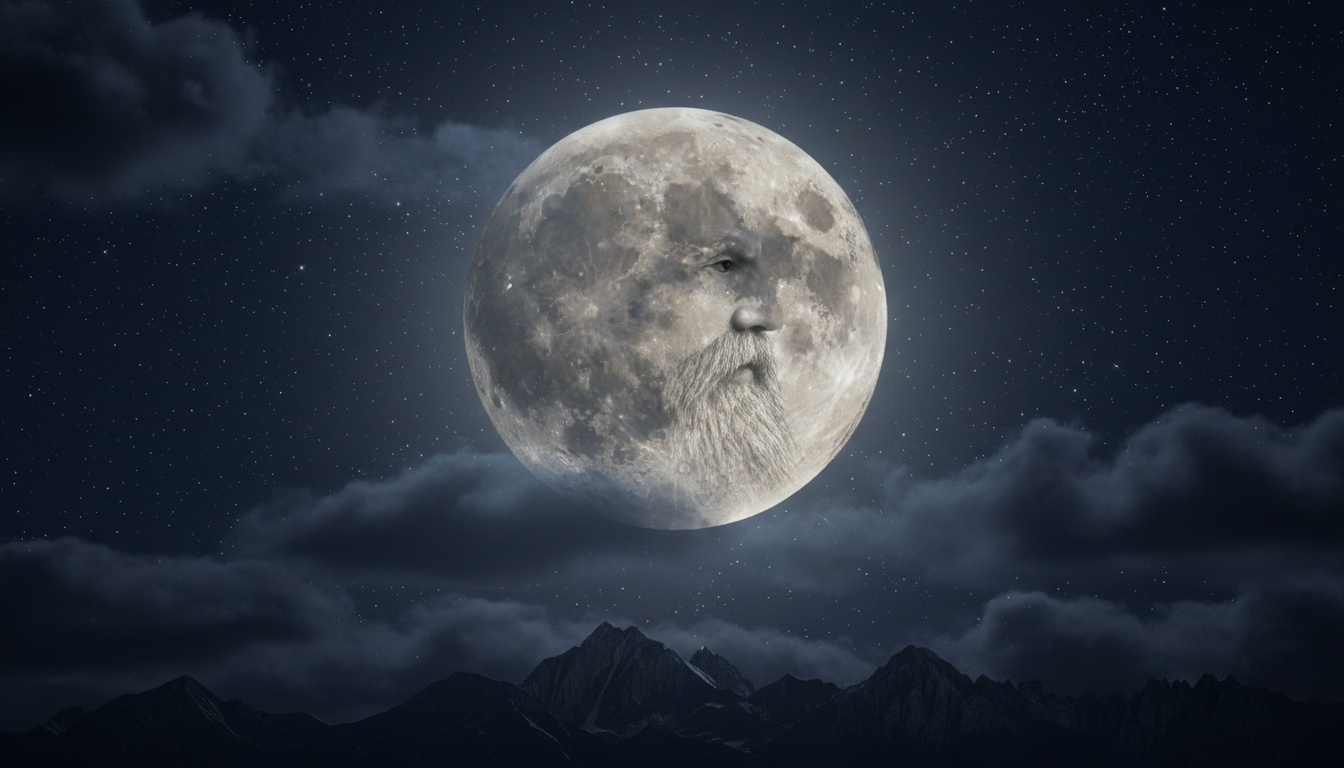
The Enduring Mystery of the Man in the Moon
For millennia, humans have gazed upward and perceived a human face etched into the lunar surface. This phenomenon, known as the Man in the Moon, transcends cultural boundaries while offering a fascinating intersection of geology, psychology, and mythology. The illusion persists despite the lifeless reality of Earth’s satellite, revealing as much about the human mind as it does about the moon’s ancient volcanic history.
Dimensions of a Celestial Illusion
- Geological Basis: Dark basaltic plains called maria create the contrast needed for facial recognition
- Psychological Mechanism: Pareidolia drives the tendency to perceive patterns in random stimuli
- Cultural Universality: Nearly every civilization has interpreted these lunar markings differently
- Historical Persistence: Documented observations span from ancient Babylon to modern telescope imagery
Cultural Resonance Across Civilizations
The perception of lunar faces varies dramatically by culture, yet the underlying phenomenon remains constant. In Western traditions, the figure often appears as a male face, sometimes accompanied by folklore about banishment or burden-bearing. Nordic folklore suggests the moon houses a man carrying sticks, while Germanic tales speak of a banished thief.
Eastern interpretations offer striking alternatives. Chinese tradition identifies the silhouette as a hare pounding the elixir of immortality, visible in the moon’s darker patches. Japanese culture similarly recognizes a rabbit, though the specific activity varies by regional telling. These interpretations demonstrate how identical visual stimuli generate divergent narratives based on cultural context.
Comparative Cultural Interpretations
| Culture | Perceived Figure | Associated Narrative |
|---|---|---|
| European | Male face | Banished biblical figure or woodcutter |
| Chinese | Jade Rabbit | Pounding the elixir of immortality |
| Hawaiian | Banana tree (Māia) | Legend of the goddess Hina |
| Aztec | Rabbit | Tecciztecatl’s sacrifice becoming the moon |
| Indian | Hare/Sasanka mark | Story of the hare in the moon (Jataka tales) |
| Inuit | Caribou/Tool-bearer | Ancestral spirits or hunting references |
The Geological Reality
The Man in the Moon’s ”eyes,” ”nose,” and ”mouth” correspond to vast impact basins filled with dark, solidified lava. These maria, Latin for ”seas,” formed approximately 3.5 to 4 billion years ago when volcanic activity flooded low-lying regions created by massive asteroid impacts. The resulting albedo contrast—dark basalt against lighter anorthosite highlands—creates the recognizable pattern visible from Earth.
Notably, the moon is tidally locked to Earth, presenting the same face consistently. This synchronous rotation ensures the perceived pattern remains constant across generations, allowing cultural narratives to stabilize over centuries. NASA’s lunar reconnaissance has mapped these formations with precision, confirming the maria’s composition while explaining the optical illusion’s durability.
Historical Observations
Documentation of lunar pareidolia extends to antiquity. Babylonian astronomers recorded observations of the moon’s ”face” as early as the 7th century BCE, often interpreting the markings as omens. Medieval European texts frequently referenced the moon’s visage in religious contexts, sometimes depicting the figure as Cain exiled to the lunar sphere.
The invention of the telescope in 1610 fundamentally altered perception. Galileo Galilei’s observations revealed the moon’s rugged, mountainous terrain, yet the popular imagination retained the facial interpretation. By the Enlightenment, scientific explanations for the dark patches—ranging from atmospheric phenomena to optical illusions—coexisted with persistent folklore. Encyclopedia Britannica documents how these dual interpretations persisted through the Scientific Revolution.
Distinguishing Perception from Reality
Modern psychology clarifies the boundary between geological fact and perceptual experience. The moon possesses no actual facial features; rather, human neurobiology prioritizes face detection as a survival mechanism evolved for social interaction. When confronted with the moon’s roughly symmetrical dark patches, the fusiform face area of the human brain processes the stimulus as a potential conspecific.
This distinction matters for understanding how scientific literacy interacts with perceptual intuition. While we now know the maria are ancient lava flows, the immediate visual experience remains unchanged. Contemporary neuroscience suggests this tension between knowledge and perception highlights the brain’s prioritization of pattern recognition over analytical processing in visual cortex functions.
Evolutionary and Cognitive Perspectives
The universality of lunar pareidolia stems from evolutionary pressures. Humans who quickly detected faces—potential threats, mates, or offspring—survived at higher rates than those requiring conscious analysis. This hyperactive agency detection device generates false positives with minimal cost, whereas false negatives (missing a predator’s face) carried fatal consequences.
Symmetry further amplifies this effect. The moon’s maria distribution possesses approximate bilateral symmetry, triggering face recognition algorithms more effectively than random patterns. Scientific American’s analysis of pareidolia notes that lunar viewing conditions—low light, high contrast, and peripheral vision usage—further lower thresholds for pattern recognition, explaining why the illusion strengthens during certain phases.
Voices Through History
”I perceive in the moon neither face nor form, but rather the wounds of ancient catastrophe—seas of frozen fire bearing witness to cosmic violence.”
— Galileo Galilei, Sidereus Nuncius (1610)
”The face in the moon is humanity’s first mirror, reflecting not light but our desperate search for the familiar in the alien.”
— Dr. Margaret Chen, Cultural Astronomer
”We are pattern-seeking mammals. To not see a face in the moon would require more cognitive effort than to see one.”
— Dr. James Parkes, Cognitive Psychologist
Summary
The Man in the Moon represents a convergence of basaltic geology and neural architecture. Ancient lava flows created the visual infrastructure; evolutionary psychology supplies the interpretive framework. While modern astronomy has demystified the maria’s origins, the experience of seeing a face remains undimmed—a reminder that human perception operates independently of objective reality.
Whether interpreted as a banished woodcutter, a cosmic hare, or simply oxidized titanium-rich basalt, the lunar illusion continues to captivate. It serves as a testament to humanity’s enduring project of imposing narrative coherence upon chaotic nature, finding familiarity in the vast indifference of space.
Frequently Asked Questions
Why do different cultures see different figures in the moon?
Cultural interpretation shapes pareidolia through narrative priming. While the neurological mechanism remains constant across populations, the specific patterns recognized depend on cultural stories transmitted through generations. Societies with strong rabbit mythology interpret the lunar shadows accordingly, while traditions emphasizing human faces see the ”Man” more prominently.
Does the moon actually look like a face from space?
No. The illusion depends entirely on viewing angle and lighting conditions specific to Earth’s perspective. Astronauts orbiting the moon report a landscape of craters and plains without facial resemblance. The albedo contrast that creates the ”face” effect is most pronounced when viewed from Earth’s distance, where fine details blur into broad patterns.
Why has the face remained visible throughout history despite environmental changes?
The moon’s tidal lock ensures consistent orientation toward Earth, and the maria’s geological features remain stable on human timescales. Unlike shifting cloud patterns or seasonal vegetation on Earth, the lunar basalts have remained unchanged for billions of years, allowing the same perceptual patterns to persist across millennia of human observation.
Can the Man in the Moon be seen during all lunar phases?
The illusion is most pronounced during full moon phases when the Earth-facing side receives maximum illumination, providing the contrast necessary for pattern recognition. During new moon or thin crescent phases, the maria receive insufficient light or are positioned at angles that disrupt the symmetrical pattern required for facial recognition.
Relaterade artiklar



Oliver Hansson är nöjesredaktör på Nyhetskanalen och bevakar musik, film, tv och kändisnyheter.